

by Deoye Falade
I was involved in a pretty interesting debate last weekend post-Manchester United trashing by Chelsea FC. A few hours after the match, the twitter account of Access Bank posted an audacious tweet promoting their Pay With Capture app by using Manchester United’s most recent transfers as a background. It was cheeky, funny and in my opinion, the outcome of brilliant on-the-fly thinking but as expected, a few people got upset.
How could they do that, rub salt in a fresh gaping wound?
The camp was divided, those who thought it was smart and funny versus those who felt it was mean-spirited, the latter mostly being the sore fans in the aftermath of a 4-0 humiliation. But I’m a Manchester United fan too, why didn’t I feel offended? Maybe because some of us understand that brands on social media are an entirely different ball game.
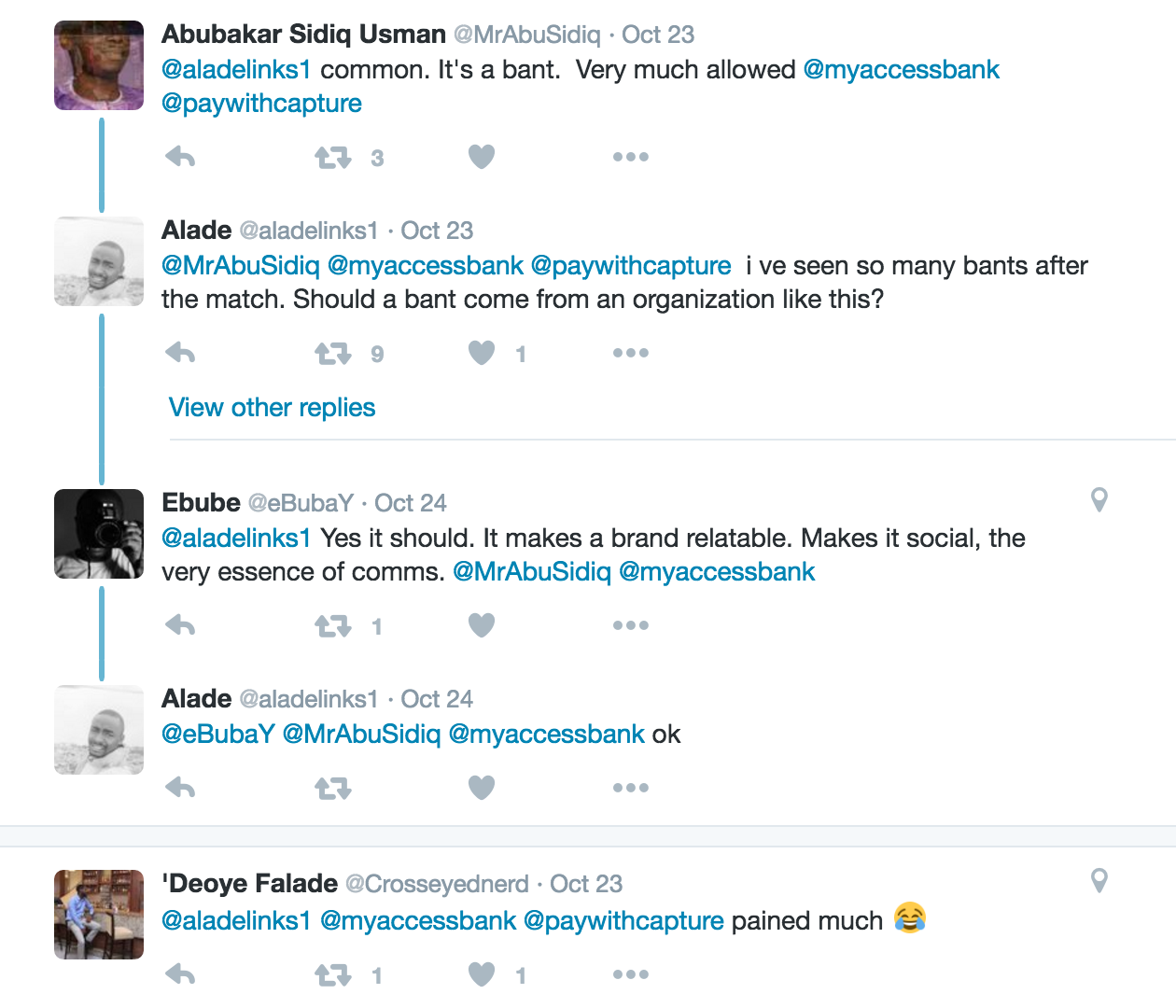
And the core of the argument was in the end two things: money and customers. And it also poses an interesting question: what does a brand stand to gain or lose by its social media activity?
Some believe that every action of a brand anywhere should be geared towards making profit and building customers. You can’t do these if people don’t like you so likeability is key. However, while this is true, there are exceptions to the rule; brands have to shape perceptions in ways that positively project them but to do this, they have to be present. This means that they have to be everywhere their existing and potential customers are.
It’s important to understand here that being present online transcends mere ‘attendance’. Participation is paramount as well; not only do brands need to be where the customers are, it must think as they do, and be interested in everything they’re interested in. Concerning our peculiar environment, this can be quite difficult and there will be some unnecessary blowback.
In this case, what I saw was a brilliant projection of the Pay With Capture application that I would probably have failed to take note of in regular advertisements, in that you can get money back off expensive purchases that fail to meet your expectations. What a few others saw was disrespect. It’s never a win-win situation in the end; while that might make me more interested in being a user, others might swear not to have anything to do with the app, or brand as farfetched as that may sound.

Abroad, Mercedes regularly indulges in online banter with BMW, BMW does same with Audi, while Cadillac trolls every competitor of them, Samsung does Apple, Microsoft guns for Google, Ebay pokes fun at Amazon and vice versa, there are tons of instances of lots of brands doing so. Fun, healthy competition, not unlike what humans do.
And this wouldn’t even be possible if brands just act true to form: inanimate, robotic, stiff. Online, brands have to be just as human as other users. And to be human is to feel, think, imitate, interact and most importantly offend (and be offended sometimes). Is the Nigerian online audience really ready for this? I think not.
Does it now mean that brands shouldn’t interact or troll the way we users regularly do? I believe the answer is still no. We are actually behind the global brands in their online interaction regarding this issue. The fact that the audience doesn’t appear to be ready shouldn’t deter brands. It’s a risk they must take; brands here actually need to inject more ‘feel’ into their online activity – they need to jump more on trends, conversations and have more personality. Really good examples of these are hotels.ng, Stanbic IBTC’s account (case in point one cheeky shade of Chelsea FC last season), DSTV, NDLEA, GTB and a few other organisations.
What brands should be careful about online is not offending racial, religious, ideological and other important sensibilities. It’s alright to joke or be personable as a brand with online presence so long as it’s not sexist, bigoted, or racist. It’s easy to laugh off a football bant and even forget about it in a week but for the aforementioned, not so much – that’s where it will cost anyone serious about their profits as well as their brand presence and perception.

Deoye Falade is a writer and media professional who works as a Content Strategist and Editor for gemWOMAN/gemMAN magazines. He also contributes features for True Nollywood Stories and other top media outlets. When he’s not being lazy or rabble rousing online, he pretends to have common sense on his blog: www.spencersmuse.wordpress.com.