

By: Yusuf Omotayo
In January 2017, George Orwell’s dystopian novel, “1984”, first published in 1949, returned to the top of the Amazon best-seller list. More than 75,000 new copies were reprinted as demand for the book increased. The reason for the spike in the book’s demand and sales was a result of a phrase used by Kellyanne Conway, the then adviser to Donald Trump.
Here is the short story:
Shortly after Donald Trump was inaugurated as president, he and the White House press secretary, Sean Spicer, had claimed that millions of Americans attended the inauguration and that the crowd was larger than that of Barack Obama. It was a false claim as data showed that the crowd was “significantly smaller and less than the 1.5 million people he claimed” according to the New York Times.
In defending Spicer’s claim after it was challenged, Conway said he gave “alternative facts.” The phrase gave off the “newspeak” language found in “1984” where truth and reality were subject to alteration and control. According to Chuck Todd, the NBC journalist, “Alternative facts are not facts. They’re falsehoods.”
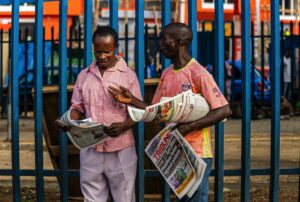
The media landscape has changed and is still evolving. For a long time, newspapers, as well as radio and television broadcasts, were the only sources of information dissemination and consumption. The advent of the internet has changed this. For a while, it was seen as a threat to journalism, which is perhaps the reason traditional news media were late to the party. Mail & Guardian was the first to launch an online news service in South Africa and Africa in 1994. However, it was still tentative in its online presence for a long time. The defunct Post Express was the first newspaper in Nigeria to move its content online. Since web pages and social media were free for anyone with internet access, newspapers were practically not making money from their online presence as paywalls and subscription models were a late addition to online journalism.
The fear of an online space where content consumption was free kept many newspapers away as they ‘gatekept’ their contents on the pages of brown papers. A few who were willing only gave snippets of their content online while they kept the big stories for ‘paying customers.’ The void was filled by bloggers and social media commentators who read the news and ran commentaries on their social media pages and blogs. In Nigeria, Linda Ikeji became a well-known blogger combining aggregated news with ‘rumours’ on her eponymous blog which she began running in 2006.
By the time newspapers and journalists finally moved to the online space, they had to struggle to take control of news narratives and jostle for space with bloggers and social media commentators and ‘influencers’. But they arrived late, and it has been difficult to beat the head start that bloggers have had. It is now a game of who can break the news first. Citizen journalists and social media reporters have also removed the exclusivity of news ownership from journalists who now fight to attain celebrity status by centring themselves rather than their stories or the subject in their stories. Truth is being sacrificed at the altar of the battle for the ownership of the media space.
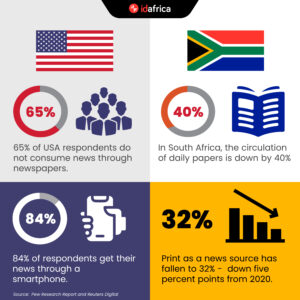
Globally, newspaper sales are dropping drastically. In the US, it is a free fall as 65% of respondents to a Pew Research report say they do not consume news through newspapers. 84% of adults say they get their news through a smartphone. Reuters Digital Report of 2021 shows that in South Africa, circulations of daily papers are down by 40% and print as a news source has fallen to 32% — down five percentage points from 2020. It is a similar story in Nigeria where print sales have gone down too.
As newspapers move to the digital space, the battle for revenue is now hinged on tech ad space (Google and Facebook) and brand advertising, as well as government patronage. These tech companies provide guidelines on topics that they push to the fore for their customers and flag some considered “unfriendly”. For example, children-friendly content attracts higher revenue and gets more reach on Facebook than hard-hitting negative news. Journalists compete with thought leaders and influencers who have amassed a large following for media attention. Tech companies that have mastered “SEO” and “A/B” testing have also cracked the ‘how to reach more readers’ space than traditional media, which means journalists and journalism are at their mercy.
Since blogs and influencers seem not to be bound by the ethics of truth but sustain their followership with gist, sensationalism and conjectures, their approach is to keep readers entertained rather than being informed. To reach the same level of audience and followership, there is the dangerous adoption of this formula by mainstream journalists who compete with ‘influencers’ and bloggers to get scoops and break news. The mantra is to “report now and confirm later and possibly delete when the story is confirmed to be untrue.”
Trust in the media in this post-truth world is dwindling and the reason is clear: If journalism is offering the same content as bloggers and ‘influencers’, of what use is the former when readers can continue to consume the latter considering they came into the market first?
Fake news, sensationalism and speculative reporting have been the inadvertent result of the relinquishing of truth for clicks and followership. South Africa’s Independent Online was accused of embarking on “a dizzying spiral of publishing misinformation and blatantly invented news.” In Nigeria, click baits and speculative reporting have also become endemic. Although trust in the media in Nigeria and South Africa is at 54% and 52% respectively, there is the danger of these numbers climbing down.
It is not all gloom though. In September 2020, Daily Maverick, a South African Online investigative news portal launched a high-quality weekly print publication called DM168. Its print has been selling 31,000 copies per week in a country recording declining newspapers. Its trust rank according to Reuters moved from 60% in 2020 to 66% in 2021. Styli Charalambous, the CEO and publisher of Daily Maverick, said: “Leading South African newspapers had suffered a string of embarrassing reports caused by incompetence and political influence. Readers had responded by abandoning print.”
In 2020, Stears, the Nigerian media company that operates Stears Business, raised $600,000 in seed funding as it looked to grow its paid subscription model. Ultimately, what this shows is that in the midst of the current wave of alternative facts sustained by a post-truth social media frenzy, real journalism buoyed by truth and fact will find a way to be sustained and patronised.
***
Yusuf Omotayo is a writer and journalist who resides in Lagos. His interests includes politics, history, human-interest stories, and a bit of pop culture. He has a special interest in how government policies affect ‘ordinary’ people.