

In the years leading to Africa’s liberation from colonialism, a new wave of political enlightenment swept across the continent. Partly ignited by the Second World War, where African soldiers were taken far away from their country to fight a war they knew nothing about and didn’t believe in, most Africans upon returning to their homelands began to see the need to demand freedom. As a result of this, the call to end colonialism in the continent began in the late 1940s and early 1950s.
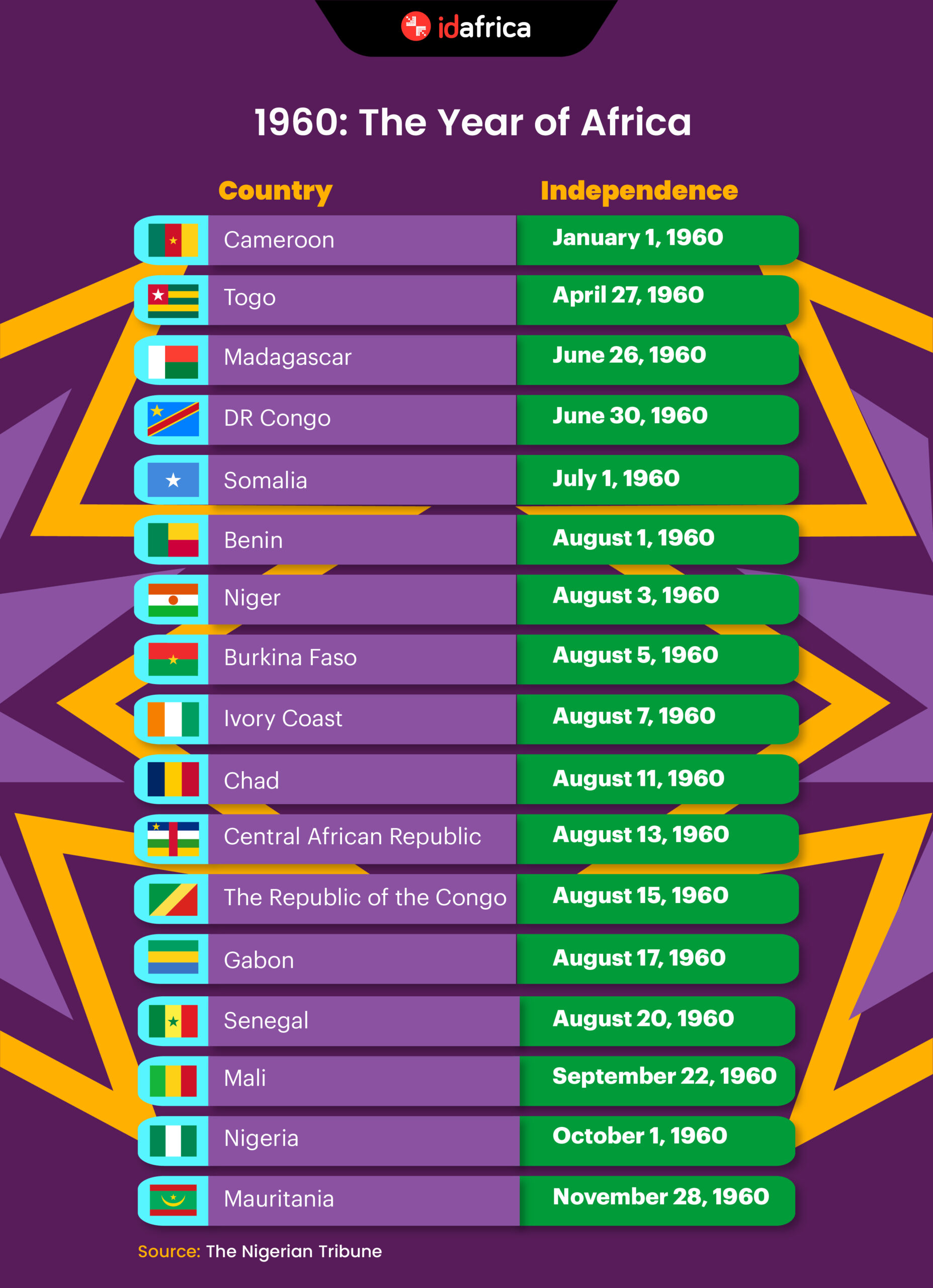
In 1960, dubbed the “Year of Africa,” 17 African countries, including Nigeria, gained independence from Belgium, France, and the United Kingdom. According to pragmatist Harold Macmillan, Former British Prime Minister (1957 – 1963) during his February 3, 1960 speech, titled, “Wind of Change,” guns were no longer enough to deter African liberation.
This decolonisation of Africa was fast-tracked by a political idealism called Pan-Africanism. Championed by Julius Nyerere, Robert Sobukwe, Haile Selassie, Kwame Nkrumah, Nnamdi Azikiwe, and later Yoweri Museveni, Robert Mugabe, Muammar Gaddafi, among others, Pan-Africanism was a political movement that created a sense of brotherhood and collaboration among all people of African descent. Hence, the news of Ghana’s independence was joyfully received by South Africans under the Apartheid regime, and the continued humiliation and marginalisation of the South African people in their homeland by white foreigners, in turn, became the humiliation of Ghanaians and all Africans in general.
Today, Pan-Africanism is still embraced by many people in Africa, including the young people who make up more than 60% of the African population and are largely a part of the decision-making process in their individual countries. In a continent where 225 million people are between the ages of 15 and 25 (United Nations, 2015), the low political engagement among the youth remains a topic of concern. A 2016 report by Afrobarometer shows that nearly 80% of citizens above 35 years old in Africa voted in the last general election compared to the 65% that comprised those between ages 18 and 35.
Exercising the right to vote is only one form of political participation. As important as it is, it appears that the 21st-century African youth remains more concerned about restoring the “African image” (by demanding a recognised and respected continent, and sometimes a call for restitution for being exploited through slavery and colonisation) rather than taking part in civic activities. While a restoration of the “African image” will benefit the entire continent, it does not start or end there.
One of the early leaders of Pan-Africanism was Kwame Nkrumah, a Lincoln University-schooled political theorist. Nkrumah became incredibly popular among the Ghanaian population, and his message of freedom appealed to many underemployed youths. While Nkrumah was studying to be a teacher at Achimota School in the early 1930s, he listened to a speech by Nnamdi Azikiwe, who later became the president of Nigeria. Nkrumah was impressed by Azikiwe’s vision for African nationalism and he embraced it. When Nkrumah eventually became the Prime Minister of Ghana in 1952, he became a force in the fight for African liberation and his advocacy led to Ghana’s independence in 1957.
When Ghana became the first Sub-Saharan African country to gain independence, a new era of hope, inspired by the euphoria of self-rule, was born on the continent. No doubt, Pan-Africanism was instrumental in African liberation, and still continues to be essential in the struggle against neocolonialism and racism.
But to begin the process of uplifting the over 460 million people who live in extreme poverty in Africa, the youth must become more politically active in their individual countries before championing a continental cause. There is an urgent need for a paradigm shift in political discourse, and while Pan-Africanism should not be discouraged, progress engendered by policies at the local and state level should be the focal point.
In an effort to champion the continuous growth and development of Africa, African states must demand better trade policies and push back on policies that are not particularly advantageous to the continent or are less of a priority. Africa needs to understand that the growth of the continent lies heavily on the micro-progresses engineered by the participation of youths in the policy-making of their respective communities, constituencies, and countries at large. The African adage “charity begins at home” speaks volume in this context.
In embracing science and technology, Africa has made enormous progress in the last decade, but this needs to be accompanied by policies that are in line with the realities of the 21st century. With more exposure to recent development in information technology and smart technology, young people who are now rapidly setting up and owning business must also express their contribution to political issues in order to achieve the favourable business environment Africa yearns for. That said, it is no longer acceptable for a continent with a vast population of young people to have only 14% of parliament members below the age of 40.
Well, that leaves everyone with the question: How can Africa achieve the needed development if a large number of its population is removed from or are unwilling to participate in the decision-making process?
***
Emmanuel Azubuike is a Staff Writer at ID Africa and is based in the Southern part of Nigeria. He is enthusiastic about telling untold African stories and driving political participation among young Nigerians.
Read the 13th edition of Africa Facts here.