
As individuals, we expect that brands on social speak proper English (preferably no ‘shorthand’), address us with respect. We anticipate responses delivered with warmth and empathy. When we need to call out an organization on social, we imagine that our posts ‘against’ them, branding them as insensitive should set off the fire alarm in their building, cause pandemonium and get every staff so concerned about how to remedy the situation.
This was not the case of the National Emergency Management Agency (NEMA) when @Adahfact asked the national organization on Twitter to reply to an accusation levelled against them by @MsNemah on July 30, 2015. The Nigerian government body that manages and provides information on disasters in Nigeria did something very unexpected.
https://twitter.com/nemanigeria/status/616227337458294784
https://twitter.com/nemanigeria/status/616227890783473664
The first line of the first reply got to everyone. “A lot of you come on social media to make noise” – seriously? It was unbelievable. But that was just the beginning.
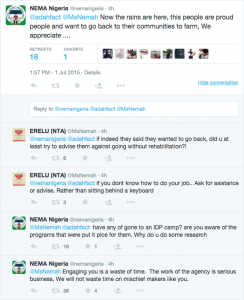
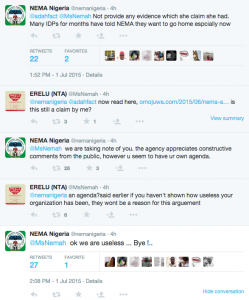
Then she delivered the punchline that has been going around new sites and blogs. She really killed it. Lool.
https://twitter.com/nemanigeria/status/616234296379056128
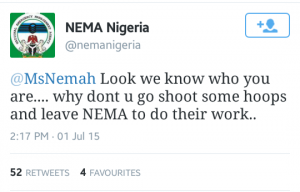
From the tone of @NEMAnigeria, we can tell it is a girl speaking, a very angry one at that. However, she took the ‘pain’ of explaining why she was so mad at @MsNemah.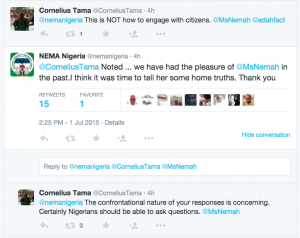
https://twitter.com/nemanigeria/status/616246363928535040
https://twitter.com/nemanigeria/status/616243363709382656
https://twitter.com/nemanigeria/status/616249250826092544
https://twitter.com/nemanigeria/status/616249588199108608
https://twitter.com/nemanigeria/status/616250212710023168
@Nemanigeria should be ready to start working on more emotional and human apology than that because of the dents and impressions the person behind the account has made.
However, there are 5 social media lessons every social media manager can learn from the NEMA case:
- If you are so feel quite irritated, angry or happy about a reply, a comment, a hashtag or a trend (whatever), do not reply with the official account of the organization you are handling. Respond on your personal platform. In NEMA’s case, she could have come at @MsNemah as a representative of the body. If allowed by her heads, she could have gone as far as defending the organization with facts. That would have been a smarter and respectable move.
-
Don’t get too emotional on an official account. To the world, you are the organization, when you reveal an identity that proves otherwise, you just might lose your integrity.
-
Ensure you have forms of responses planned. You can be explanatory, empathetic, factual, funny or deaf.
-
Drop your attitude before you touch that account. Tweet-fighting is so not an option.
-
As much as social media is cool, young and fun, if you represent an organization, it’s best you stick to proper English.
People are watching you. Keep that organization’s image flawless.